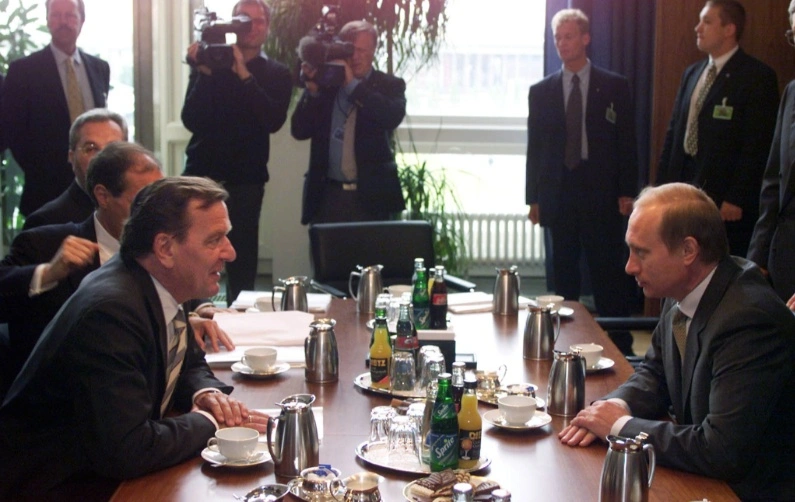
Former German Chancellor Schröder criticised for attending Putin's birthday
Section: News
The Organisation for Economic Co-operation and Development (OECD) projects a gradual recovery for Austria's economy over the next two years, though growth is expected to remain subdued compared to international averages. According to the latest OECD economic outlook, Austria's gross domestic product (GDP) is forecast to increase by 0.9% in 2026 and 1.2% in 2027, following a modest rise of 0.3% this year. These figures indicate a slower pace of expansion than previously anticipated and place Austria below both the OECD and eurozone averages.
Across the OECD, member countries are expected to achieve GDP growth of 1.7% in both 2026 and 2027, while the eurozone is projected to see growth rates of 1.2% and 1.4% over the same period. The G20 economies are forecasted to expand by 1.7% in 2026 and 1.8% in 2027. For Germany, Austria's primary trading partner, the OECD anticipates growth of 1% in 2026 and 1.5% in 2027. Globally, the economic outlook is somewhat brighter, with the OECD estimating world GDP growth at 2.9% in 2026 and 3.1% in 2027, despite ongoing geopolitical uncertainties and trade barriers.
The OECD notes that while higher tariffs, particularly those proposed by the United States on imports, have introduced some volatility to international trade, their overall negative impact has been less severe than initially feared. Nonetheless, these measures are expected to gradually contribute to higher prices. For Austria, which conducts around two-thirds of its trade within the European Union and is deeply integrated into regional supply chains, shifts in global trade policies, especially US tariffs on EU goods, could have a tangible effect on exports. Approximately 21% of Austrian exports are intermediate goods used in foreign partners' exports, making the country sensitive to changes in global demand.
The OECD also highlights that Austria may benefit from increased government spending in Germany in 2027, which could help support demand for Austrian exports. Domestically, the OECD expects private consumption to strengthen over the next two years, supported by declining inflation, a robust labor market, and lower household savings. Additionally, low interest rates are anticipated to spur greater investment. Inflation in Austria is projected to approach the target level of 2% by the end of 2027. However, potential risks remain, including continued economic weakness in Europe and further trade shocks, which could hinder the pace of recovery.
To enhance economic resilience and boost growth, the OECD recommends targeted public investments to foster greater business dynamism. Measures such as expanding broadband infrastructure, easing infrastructure regulations, and introducing investment incentives could stimulate medium-term growth. The OECD also suggests reforming land-use regulations and removing restrictions in the housing market. Furthermore, a more integrated and competitive energy market could help lower energy costs, particularly for energy-intensive industries.
The OECD cautions that Austria's ongoing fiscal consolidation efforts may slightly dampen economic momentum by constraining demand. The report also underscores the need for structural reforms to address long-term challenges such as population aging, climate change, and rising defense expenditures. Reforms in public finances, including adjustments to the pension system and social benefits, are deemed necessary to strengthen economic prospects. The OECD emphasizes that these recommendations are not unique to Austria but apply broadly to many advanced economies, calling on policymakers to address underlying vulnerabilities, implement structural reforms, and optimize public finances to sustainably improve growth and living standards.
Section: News

Section: Science

Section: Business

Section: Business

Section: Science

Section: News

Section: Politics

Section: News

Section: Fashion

Section: Arts
Both private Health Insurance in Germany and public insurance, is often complicated to navigate, not to mention expensive. As an expat, you are required to navigate this landscape within weeks of arriving, so check our FAQ on PKV. For our guide on resources and access to agents who can give you a competitive quote, try our PKV Calculator.
Germany is famous for its medical expertise and extensive number of hospitals and clinics. See this comprehensive directory of hospitals and clinics across the country, complete with links to their websites, addresses, contact info, and specializations/services.
Didn't manage to get a ticket for Linkin Park? Or still not enough after the concert? Join us at CRASH on June 12th for our "IN THE END" Linkin Park Special + CORE NIGHT.All night long, we'll be playing Linkin Park's music, along with Nu Metal, Metalcore, and Alternative Rock from bands such as Limp...



No comments yet. Be the first to comment!