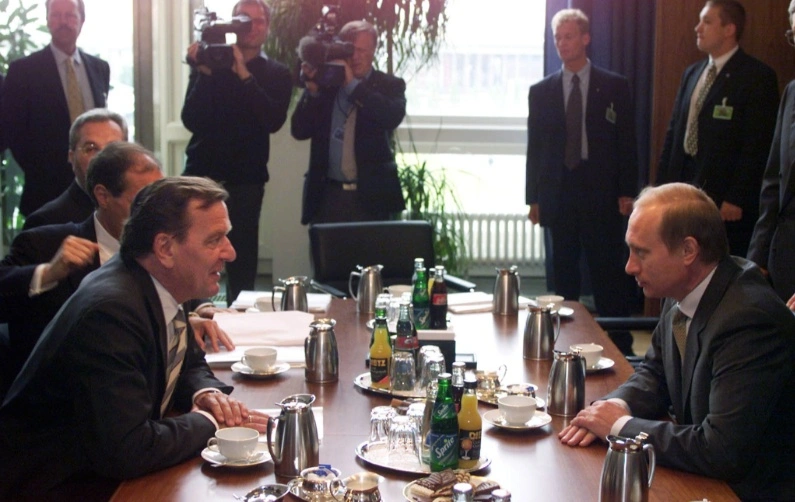
Former German Chancellor Schröder criticised for attending Putin's birthday
Section: News
Mercedes-Benz, one of Germany's largest companies with approximately 175,000 employees, is currently experiencing a significant downturn in earnings. The company's latest financial results revealed that its operating profit has more than halved, with profit margins falling from just over 8 percent in the previous year to 2.8 percent in the last quarter of 2025. This decline is attributed to steep drops in sales across major markets, including a 34 percent decrease in China and a 19 percent decline in the United States. This marks the second consecutive year of reduced profits for Mercedes-Benz, prompting the company to lower its outlook for 2026.
This situation is emblematic of broader difficulties within the European automotive sector. Other major manufacturers, such as Volvo Cars and Ford, have reported similarly disappointing figures. Recently, Volvo Cars' financial results led to a near 30 percent drop in the company's share price, while the Ford Group announced a loss of approximately 73 billion SEK for 2025. Ford's market share in Europe has plummeted from around 8 percent to below 3 percent in just a few years. BMW and Volkswagen are also expected to report declining profit margins and have issued profit warnings.
The automotive industry, which employs nearly 14 million people across the European Union, is facing significant structural challenges. An estimated 100,000 jobs in the European automotive sector have been lost during 2024 and 2025, and more may be at risk if current trends persist. Against this backdrop, the success of new electric SUVs, such as Volvo's EX60, BMW's IX3, and Mercedes' GLC, is considered crucial for the future of these companies.
Several key factors are driving these difficulties:
The European automotive industry now faces a pivotal moment as it enters what is being described as a new phase of competition in the electric vehicle sector. Failure by established brands like Mercedes-Benz and BMW to adapt successfully could result in further job losses and have significant political and economic repercussions across Europe, particularly as populist movements gain traction in several major countries.
Section: News

Section: Science
Section: Business

Section: Business
Section: Science

Section: News
Section: Politics
Section: News

Section: Fashion

Section: Arts
Both private Health Insurance in Germany and public insurance, is often complicated to navigate, not to mention expensive. As an expat, you are required to navigate this landscape within weeks of arriving, so check our FAQ on PKV. For our guide on resources and access to agents who can give you a competitive quote, try our PKV Calculator.
Germany is famous for its medical expertise and extensive number of hospitals and clinics. See this comprehensive directory of hospitals and clinics across the country, complete with links to their websites, addresses, contact info, and specializations/services.
Didn't manage to get a ticket for Linkin Park? Or still not enough after the concert? Join us at CRASH on June 12th for our "IN THE END" Linkin Park Special + CORE NIGHT.All night long, we'll be playing Linkin Park's music, along with Nu Metal, Metalcore, and Alternative Rock from bands such as Limp...



No comments yet. Be the first to comment!