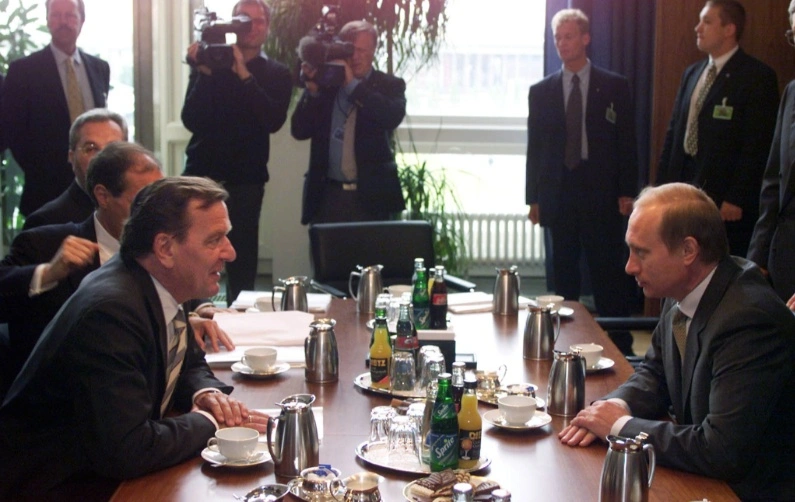
Former German Chancellor Schröder criticised for attending Putin's birthday
Section: News
The recent NATO summit in The Hague highlighted underlying tensions within the alliance, despite the ceremonial hospitality extended to the U.S. President. The summit began with elaborate arrangements, including a royal dinner hosted by the Dutch monarchy, aimed at showcasing President Trump's pivotal role in NATO.
In the lead-up to the summit, NATO's Secretary-General engaged in extensive efforts to flatter Trump, believing that these measures would facilitate a unified stance on defense spending. As the meeting commenced, the Secretary-General emphasized the long-standing burden borne by the United States in terms of NATO's defense expenditures, asserting that it was time for European nations to assume greater responsibility.
Despite reaching a consensus on a new defense spending goal, which aligns with Trump's demand for 5% of GDP contributions, fractures within NATO became evident. The fundamental principle of collective defense, as enshrined in Article 5 of the NATO treaty, was brought into question, particularly following Trump's ambiguous comments on his commitment to this principle.
During his journey to The Hague, Trump suggested that his interpretation of Article 5 could vary, casting doubt on the U.S. commitment to defend its NATO allies. This uncertainty raises critical questions about the extent to which the United States would engage its military forces in defense of European nations.
Additionally, discussions surrounding the ambitious defense spending target revealed further divisions among member countries. A proposal to extend the deadline for achieving the 5% goal to 2035 was met with resistance from countries like Spain, whose Prime Minister asserted that his nation could meet NATO's military capability requirements without reaching the proposed spending threshold.
In a related vein, the summit revealed differing perspectives on the threat posed by Russia, particularly in light of its ongoing aggression against Ukraine. While NATO allies previously affirmed Ukraine's path toward membership as irrevocable, such assurances were notably absent in the current discussions. Ukraine's President, Volodymyr Zelenskyy, was present at the summit and engaged with various leaders, although the outcome of his anticipated meeting with Trump remained uncertain due to the latter's unpredictable schedule.
As NATO leaders continued to address the looming threat from Russia, there was a notable divergence in viewpoints. While many leaders underscored Russia as the primary threat to European peace and security, Hungary's Prime Minister articulated a contrasting view, emphasizing economic challenges over security concerns. This divergence further reveals the complexities within the alliance, particularly in light of Trump's previous threats regarding tariffs.
Section: News

Section: Science
Section: Business

Section: Business
Section: Science
Section: News
Section: Politics
Section: News

Section: Fashion
Section: Arts
Both private Health Insurance in Germany and public insurance, is often complicated to navigate, not to mention expensive. As an expat, you are required to navigate this landscape within weeks of arriving, so check our FAQ on PKV. For our guide on resources and access to agents who can give you a competitive quote, try our PKV Calculator.
Germany is famous for its medical expertise and extensive number of hospitals and clinics. See this comprehensive directory of hospitals and clinics across the country, complete with links to their websites, addresses, contact info, and specializations/services.
Didn't manage to get a ticket for Linkin Park? Or still not enough after the concert? Join us at CRASH on June 12th for our "IN THE END" Linkin Park Special + CORE NIGHT.All night long, we'll be playing Linkin Park's music, along with Nu Metal, Metalcore, and Alternative Rock from bands such as Limp...



No comments yet. Be the first to comment!