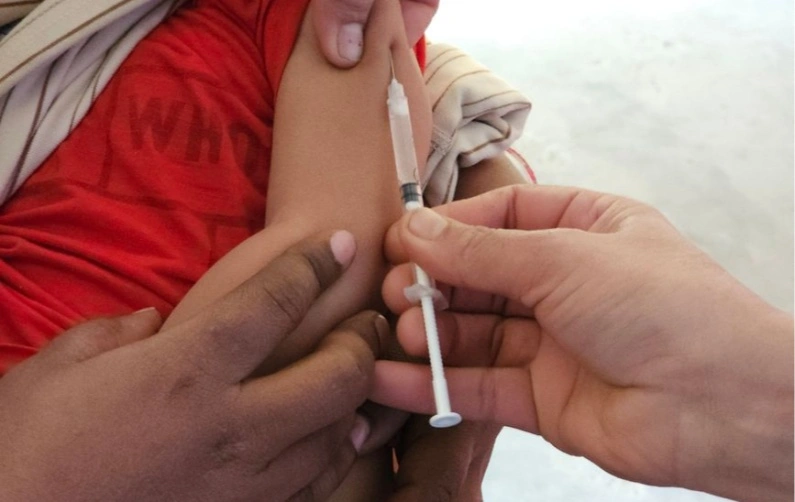
Child Vaccination Rates Decline in Germany Amid Health Concerns
Section: Health
The apartment was once filled with life but now stands vacant. Shoes and boots are neatly arranged in the hallway, and a small chalkboard on the wall bears reminders about daily activities, though it hasn't been updated since December. This is the home of Adam, a young man now incarcerated, as his mother Ingeli sorts through his belongings while her partner Anders cleans out the refrigerator.
On a pillow in the bedroom rests a well-loved stuffed animal, affectionately named 'Dog.' This toy has been a silent companion for Adam and his mother during difficult conversations. Ingeli recalls using it as a tool to help communicate with Adam when he was younger, often finding it easier to express thoughts and feelings through the toy.
Adam, described as a lively young man in his twenties, has a moderate intellectual disability, and according to his mother, his cognitive abilities are comparable to those of a child aged six to eight years. He struggles with basic tasks like tying his shoes and reading a clock. Concepts of time, such as understanding the difference between tomorrow, next week, and summer, are challenging for him. Ingeli expresses concern that Adam may not fully comprehend the concept of death.
Despite his limitations, Adam was convicted of conspiracy to commit murder, a serious charge stemming from an investigation where he was allegedly recruited via social media to assist in planning a murder in Dubai. Ingeli believes that Adam, due to his need for social connection, was manipulated by criminal elements.
Authorities have been unable to identify the individuals who recruited Adam, who are referred to in legal documents as the instigators. Both the prosecutor and Adam's defense attorney have suggested that these individuals likely have gang affiliations. The prosecutor, Sharareh Ghavam Nejad, noted that such recruitment tactics are common among network criminals who target vulnerable individuals.
Evidence collected includes encrypted messages where unidentifiable individuals discuss Adam's supposed mission. In these communications, they ask Adam for a photo of his passport to arrange travel to Dubai. Adam, however, appears confused about the requirements for travel, mistakenly thinking his ID card would suffice instead of a passport.
After meeting the instigators in Stockholm, Adam and his mother reported the threats made against them to the police. Initially, Adam was considered a victim, but the situation shifted when he retrieved his passport and attempted to travel to the airport. He was apprehended by police at the central station before he could board a flight.
In court, the prosecution used Adam's actions--such as retrieving his passport and expressing intentions to travel--as evidence of his involvement in the conspiracy. The legal definition of conspiracy encompasses making plans in agreement with others to commit a crime. However, Adam's defense argues that he lacks the capability to execute such plans independently.
Adam's conviction also included charges of making threats and violating knife laws, which may have influenced the court's decision. His case is currently under appeal, and he remains detained while awaiting a ruling from the higher court. Following a period in a detention facility, he has been transferred to a psychiatric institution, as his sentence includes treatment rather than imprisonment.
Ingeli emphasizes that Adam's intellectual disability does not equate to a mental illness, challenging the appropriateness of his placement in a psychiatric setting. She advocates for a system that better accommodates individuals like Adam, who require support without being subjected to the same legal processes as those without disabilities.
In Sweden, the legal framework does not adequately address the concept of 'accountability' for individuals with intellectual disabilities, contrasting with practices in other Western nations that provide alternative measures for such individuals. The current Swedish system allows for accountability during the prosecution but shifts to a medical model when sentencing, where the focus is on treatment rather than justice.
Experts in the field have called for reform, arguing that individuals with intellectual disabilities require a more nuanced approach within the justice system to prevent them from being subjected to processes they do not understand.
Section: Health

Section: Politics

Section: Politics

Section: Business

Section: Business

Section: Arts

Section: Business

Section: News

Section: Business

Section: News
Both private Health Insurance in Germany and public insurance, is often complicated to navigate, not to mention expensive. As an expat, you are required to navigate this landscape within weeks of arriving, so check our FAQ on PKV. For our guide on resources and access to agents who can give you a competitive quote, try our PKV Calculator.
Germany is famous for its medical expertise and extensive number of hospitals and clinics. See this comprehensive directory of hospitals and clinics across the country, complete with links to their websites, addresses, contact info, and specializations/services.
Didn't manage to get a ticket for Linkin Park? Or still not enough after the concert? Join us at CRASH on June 12th for our "IN THE END" Linkin Park Special + CORE NIGHT.All night long, we'll be playing Linkin Park's music, along with Nu Metal, Metalcore, and Alternative Rock from bands such as Limp...



No comments yet. Be the first to comment!