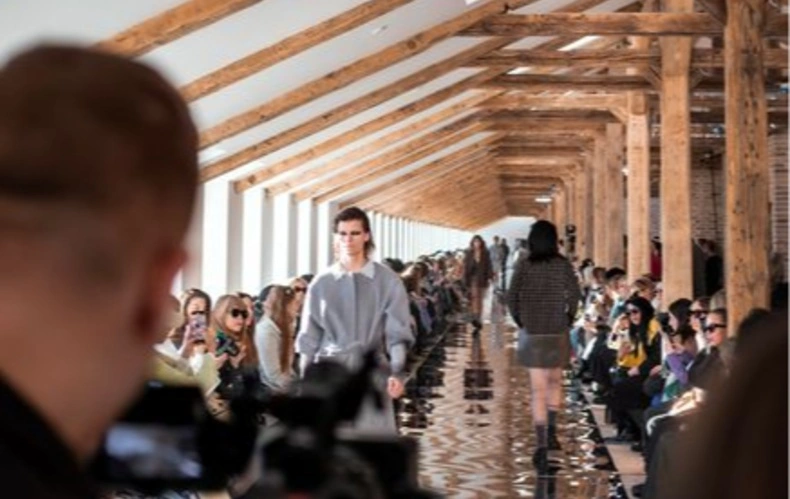
Why Marie Antoinette Showed Up All Over Fashion Week This Year
Section: Fashion
Within the context of the Christian Easter celebrations, there exists a peculiar day marked by a notable absence of events. The long Friday, in stark contrast, is filled with significant occurrences: judgment, crucifixion, darkness, abandonment, and death. Churches and chapels present bare altars, flowers removed, and candles extinguished. This day symbolizes the death of love itself, as interpreted by Christian beliefs. Such themes resonate with our contemporary reality, casting a shadow that seems to envelop us.
Yet, the narrative shifts with the arrival of Easter Sunday, a day dedicated to life and light, characterized by vibrant altars, festively set tables, and jubilant hymns. Easter Sunday embodies an idealistic vision, perhaps more challenging to perceive at first glance, but it embodies every hope that darkness will not prevail, that a positive resolution is possible.
Between the lamentation of Good Friday and the celebration of Easter Sunday lies this enigmatic Saturday, a day where nothing appears to unfold. However, biblical texts hint at cryptic references to what would later be articulated in the Nicene Creed as 'descendit ad inferna'--the descent into hell. What is the implication of this descent? Does it signify Christ's ultimate victory over death, or does it reflect solidarity with those estranged from divine communion, engulfed in the depths of despair and death? The concepts of gehenna and hades suggest profound meanings in this context.
The Christian church lacks a definitive theology concerning the significance of this day, which may be appropriate. For those of us still living on this earth, this Saturday primarily represents a time of anticipation.
Such was my perception until I encountered George Steiner's remarkable work, 'Real Presences.' Steiner, a notable figure in post-war literary criticism, was born into a Jewish family in Paris in 1929 and fled to New York just before the Nazi occupation. His extensive academic journey took him through institutions such as Chicago, Harvard, and Oxford, and he settled in Cambridge while holding a professorship in literature in Geneva. He epitomizes the quintessential Central European Jewish intellectual transformed into a cosmopolitan.
'Real Presences' has garnered a cult following in certain circles, primarily examining whether significant art can be created, experienced, and appreciated within a cultural framework that does not recognize its relationship with the transcendent, where the question of God is no longer deemed urgent. In simple terms, can genuine art emerge from a thoroughly secular society? This query may provoke a defensive response--of course, it can. After all, many prominent 20th-century artists and writers identify as agnostics or atheists. However, such responses overlook the crux of the issue.
Steiner's inquiry is not centered on whether great art necessitates the artist's personal belief but rather if it demands a fundamental 'experience' of God, whether as an overwhelming presence or as a profound absence. The opposing view would be a truly radical secularism, one that no longer exists as a parasite on what it denies, finding comfort in a completely disenchanted world, immanent and closed.
Steiner's question challenges us to consider if we can even envision significant art emerging from such a cultural soil. While kitsch, trivial entertainment, and pornography may flourish, can secularism alone provide sufficient existential depth? Does it possess the moral gravitas necessary to meaningfully engage with beauty? Can it endure after severing ties with humanity's deepest cultural roots, from prehistoric cave paintings to modern abstract art?
The answers remain elusive. No one has yet tested such a cultural framework. One cannot conceive of Albert Camus without his absurd rebellion against a silent world, nor can John Steinbeck's profound explorations of good and evil be imagined as mere projections of humanity. Likewise, the existential angst portrayed by Pär Lagerkvist cannot be reconciled with a comfortable engagement in the immanent.
Steiner's arguments gain relevance as recent discussions in Sweden revive the question of divine existence, closely related to public debates sparked by Per Wirtén's commentary on the resurgence of romanticism as a symptom of a conservative and nationalistic shift. Critics such as Ludvig Lindelöf, Eric Schüldt, and Sandra Stiskalo argue that this romantic revival reflects a discomfort with the disenchantment of a secular worldview. Consequently, discussions about the existence of God have surfaced in mainstream media, revealing a surprising engagement with religious philosophy.
However, underlying this dialogue is a deeper question that has yet to be fully addressed, one that transcends the existence of God and focuses on the essence of art itself. Steiner's troubling query: 'Can there be, strictly speaking, a secular poetics?' Is it possible to articulate profound aesthetic experiences of meaning within a purely immanent framework? Can Rainer Maria Rilke's encounter with the archaic torso--an experience demanding transformation--be understood solely within a secular context?
William Butler Yeats posited that 'no one can create like Shakespeare, Homer, or Sophocles unless they genuinely believe in the immortality of the human soul.' Steiner's iteration of this theme suggests that true engagement with art requires a willingness to transcend the bounds of skeptical rationality, finding a home in immanence and verification. We must approach literature and art with the assumption that these forms convey a meaningful reality beyond our grasp.
According to Steiner, the essence of art, literature, and music lies in conveying an intrinsic significance that exists independent of our control; it approaches us and invites us to partake in it. If we open ourselves to this experience, what might we encounter? Steiner's response is the notion of 'real presence'--the aesthetic experience that seeks to express the ineffable yet profoundly meaningful, which it can never fully encapsulate but occasionally brushes against. Plato referred to this as 'the true reality.' We may call it transcendence or the traces of the great Creator evident in our modest creations.
If Steiner's assertions hold true, art demonstrates that our brief lives are not governed solely by the logic of despair, as if aesthetic pursuits can only attest to meaningless darkness. Indeed, art must grapple honestly with mortality and the moments when justice and love face persecution. Yet, if we remain entrenched in this narrative, nihilism prevails, leaving us in a hellish existence. Conversely, through the aesthetic experience, we can narrate the good, the true, and the beautiful, grasping hope and anticipating the utopian promise of resurrection.
Thus, the Saturday nestled between Good Friday and Easter Sunday, in Steiner's perspective, serves as a metaphor for the conditions and possibilities of art, literature, and music. Without a vital connection to the reality that aesthetic forms--through a miraculous process--communicate during the long day of despair and hope, how could we endure?
Section: Fashion

Section: Health

Section: Politics

Section: Politics

Section: Business
Section: Business
Section: Arts

Section: Business

Section: News

Section: Business
Both private Health Insurance in Germany and public insurance, is often complicated to navigate, not to mention expensive. As an expat, you are required to navigate this landscape within weeks of arriving, so check our FAQ on PKV. For our guide on resources and access to agents who can give you a competitive quote, try our PKV Calculator.
Germany is famous for its medical expertise and extensive number of hospitals and clinics. See this comprehensive directory of hospitals and clinics across the country, complete with links to their websites, addresses, contact info, and specializations/services.
Didn't manage to get a ticket for Linkin Park? Or still not enough after the concert? Join us at CRASH on June 12th for our "IN THE END" Linkin Park Special + CORE NIGHT.All night long, we'll be playing Linkin Park's music, along with Nu Metal, Metalcore, and Alternative Rock from bands such as Limp...



No comments yet. Be the first to comment!