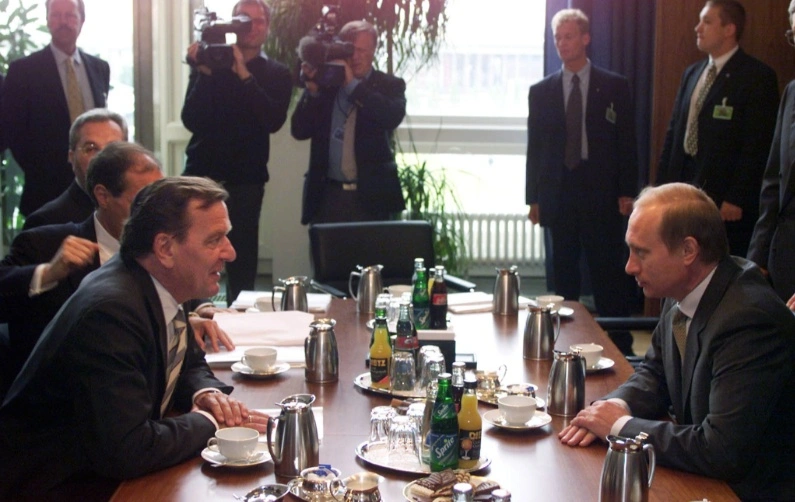
Former German Chancellor Schröder criticised for attending Putin's birthday
Section: News
Carinthian Governor Daniel Fellner has made his inaugural appearance at the Committee of the Regions in the European Parliament in Brussels, focusing on the forthcoming multi-year European Union budget for 2028 to 2034. Fellner participated in discussions with Austria's Permanent Representative to the EU, Gregor Schusterschitz, and attended multiple sessions addressing the critical role of regional input in the allocation of EU funds.
Throughout his engagements, Fellner underscored the unified stance of Carinthia and other European regions in seeking greater involvement in decisions about the distribution of EU financial resources. According to Fellner, regions are best positioned to understand and advocate for the needs of their populations, making their participation in budgetary decisions essential. He expressed concerns about ongoing centralization efforts, arguing that such moves could diminish the influence of local authorities and negatively affect regional interests.
The governor pointed to the current approach of the Austrian federal government, stating that the federal authorities have not sufficiently integrated the states into the EU budget planning process. This, he argued, could limit the effectiveness of regional projects and hinder the ability to secure EU co-financing for vital infrastructure developments.
One major initiative highlighted during Fellner's visit is the 'Wasserschiene' project in Carinthia. This large-scale infrastructure plan involves the construction of a 135-kilometre water pipeline network connecting Villach, Klagenfurt, St. Veit, and Feldkirchen. Designed to address water shortages and adapt to future climatic changes, the system will be capable of transporting up to 200 litres of water per second across the region, ensuring supply even during droughts or local disruptions. Part of the network will be laid directly in Lake Wörthersee between Klagenfurt and Velden. Of the estimated EUR135 million cost, 51 percent is expected to be financed by the regional government, with the remainder covered by the national government and participating municipalities. Fellner emphasized that securing EU funding would be crucial for the project's completion and long-term sustainability.
Fellner's speech in the European Parliament also addressed the interconnected challenges of climate change and the need for cross-border cooperation. He noted that environmental crises do not respect national boundaries, and thus, both preventive and emergency measures should be coordinated internationally. Carinthia has prioritized collaborative solutions and has established successful partnerships with neighbouring regions, including Friuli Venezia Giulia and Veneto in Italy. Their joint civil protection agreement, which recently received the European 'Building Europe across borders 2026' award, exemplifies effective transnational cooperation and the benefits of shared strategies for crisis management.
The governor concluded that, as Europe faces increasingly complex challenges, fostering stronger collaboration at all levels--including within smaller regional structures--will be essential. He maintained that greater regional participation is not only beneficial for local communities but also strengthens the European project as a whole.
Section: News

Section: Science
Section: Business

Section: Business
Section: Science
Section: News
Section: Politics
Section: News

Section: Fashion
Section: Arts
Both private Health Insurance in Germany and public insurance, is often complicated to navigate, not to mention expensive. As an expat, you are required to navigate this landscape within weeks of arriving, so check our FAQ on PKV. For our guide on resources and access to agents who can give you a competitive quote, try our PKV Calculator.
Germany is famous for its medical expertise and extensive number of hospitals and clinics. See this comprehensive directory of hospitals and clinics across the country, complete with links to their websites, addresses, contact info, and specializations/services.
Didn't manage to get a ticket for Linkin Park? Or still not enough after the concert? Join us at CRASH on June 12th for our "IN THE END" Linkin Park Special + CORE NIGHT.All night long, we'll be playing Linkin Park's music, along with Nu Metal, Metalcore, and Alternative Rock from bands such as Limp...



No comments yet. Be the first to comment!