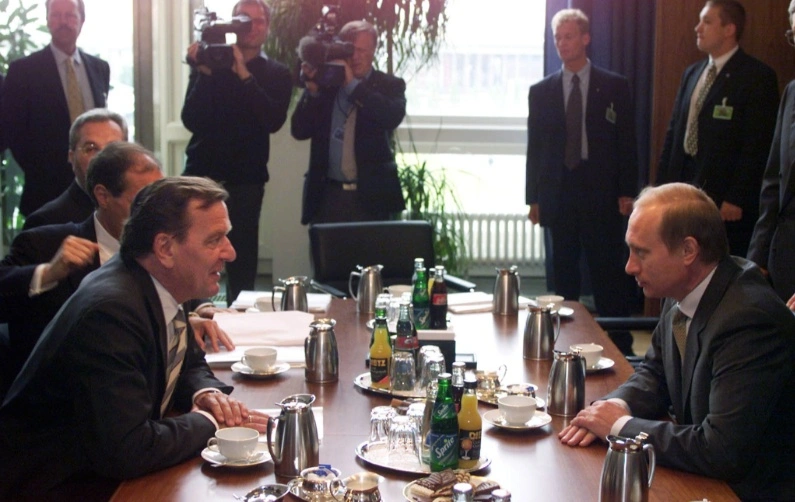
Former German Chancellor Schröder criticised for attending Putin's birthday
Section: News
In a recent joint cabinet meeting held in Neubrandenburg, the governments of Brandenburg and Mecklenburg-Vorpommern have reached a significant agreement aimed at improving regional train services. Starting from the next timetable change, trains along the route from Berlin through Angermünde and Pasewalk to Stralsund will operate on an hourly basis, a move that is expected to greatly benefit commuters, tourists, and local economies.
Mecklenburg-Vorpommern's government leader emphasized the importance of these developments for enhancing mobility and strengthening cross-border connections, particularly towards Poland. There is a specific call for expedited efforts from the federal government to enhance railway links to Poland, especially to the city of Szczecin.
To facilitate the new hourly service on the Vorpommern Magistrale, Mecklenburg-Vorpommern will contribute EUR3.2 million annually. By 2027, the plan includes direct train services without the need for transfers, further improving connectivity.
Brandenburg's government leader articulated a clear vision for better transport links, which includes not only the enhancement of train services but also the improvement of critical road networks. Key projects mentioned include the swift advancement of the B 189 road from Wittstock to Mirow and the continuation of the A14 highway, which is missing a segment between Magdeburg and Wittenberge. Additionally, plans to accelerate the development of the B 96 road were announced, supported by additional staffing resources.
Both leaders criticized the lengthy planning and approval processes associated with infrastructure projects, calling for reforms to significantly reduce the timeline from the current 20 to 25 years. The Brandenburg government leader suggested that a model similar to the Traffic Route Acceleration Law from the early 1990s could be an effective solution.
Another significant issue discussed was the urgent need to expand the oil pipeline from the Rostock port to the PCK refinery in Schwedt. This project has been labeled a key element in maintaining economic viability and securing jobs in the region. The leaders urged the federal government to prioritize this expansion, especially following the cessation of Russian oil imports due to geopolitical tensions.
Additionally, both leaders highlighted the paradox faced by their states: while they are leaders in renewable energy production, they also contend with some of the highest electricity prices in Germany. They called for reforms that ensure the benefits of renewable energy are reflected in lower prices for consumers and businesses alike, emphasizing that the fair distribution of federal infrastructure investment funds is crucial for the development of Eastern German states.
As they prepare for the upcoming East German Minister-Presidents' conference, the leaders plan to continue advocating for equitable treatment of their regions in terms of federal funding and support for infrastructure and climate initiatives.
Section: News

Section: Science
Section: Business

Section: Business
Section: Science
Section: News
Section: Politics
Section: News

Section: Fashion
Section: Arts
Both private Health Insurance in Germany and public insurance, is often complicated to navigate, not to mention expensive. As an expat, you are required to navigate this landscape within weeks of arriving, so check our FAQ on PKV. For our guide on resources and access to agents who can give you a competitive quote, try our PKV Calculator.
Germany is famous for its medical expertise and extensive number of hospitals and clinics. See this comprehensive directory of hospitals and clinics across the country, complete with links to their websites, addresses, contact info, and specializations/services.
Didn't manage to get a ticket for Linkin Park? Or still not enough after the concert? Join us at CRASH on June 12th for our "IN THE END" Linkin Park Special + CORE NIGHT.All night long, we'll be playing Linkin Park's music, along with Nu Metal, Metalcore, and Alternative Rock from bands such as Limp...



No comments yet. Be the first to comment!