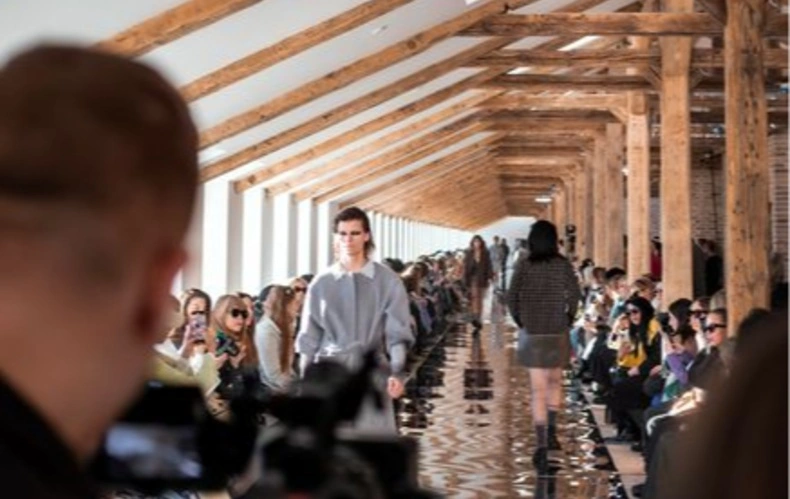
Why Marie Antoinette Showed Up All Over Fashion Week This Year
Section: Fashion
Recent surveys and expert analyses indicate that, despite minor setbacks, the Social Democratic Party of Austria (SPÖ) is on track for a solid victory in the upcoming Vienna municipal elections scheduled for April 27. The Freedom Party of Austria (FPÖ) is expected to significantly increase its presence, potentially securing the second position with a tripling of its previous election results. However, the composition of the new city government remains uncertain and will be shaped by a competitive race among other parties.
According to political analyst Wolfgang Bachmayer, the current election campaign has been characterized as a 'non-campaign', primarily revolving around party-centric issues such as the controversial Lobau highway project. These topics have not garnered substantial public or media attention, which Bachmayer attributes to the ongoing national government formation process that has diverted media focus and contributed to voter fatigue. This overshadowing effect could lead to lower voter turnout in the upcoming elections.
Christoph Haselmayer, another political analyst, echoes this sentiment, predicting that voter participation will likely be lower than usual, particularly in comparison to other regions. He notes that the key question for the parties is who will be able to mobilize their voters effectively, as the prevailing election sentiment seems to have not resonated with the public. Despite this potentially unfavorable scenario for the SPÖ, Haselmayer believes that the voting demographic, particularly seniors over 60, who traditionally support the SPÖ, may still turn out in higher numbers than younger voters in the 40-60 age group, where the FPÖ has more appeal.
The SPÖ has strategically positioned itself as a 'Vienna party', a move that Haselmayer believes was prudent. The party's messaging has focused on assuring the public that Vienna is in capable hands, a sentiment supported by Bachmayer. Currently, safety is a significant concern among Vienna residents, but this issue is not monopolized by any single party, leading to a more collaborative election atmosphere compared to past contests. There is a notable absence of a direct confrontation akin to previous elections.
Both experts agree on the dominance of Mayor Michael Ludwig, stating that he outshines other candidates. Ludwig's popularity could potentially elevate the party's overall performance, particularly in a hypothetical direct election scenario. In contrast, FPÖ candidate Dominik Nepp could also attract significant voter support, indicating that he could perform as well as his party. Conversely, the ÖVP's Karl Mahrer faces challenges, including potential legal issues that complicate his campaign's viability.
The Green Party and NEOS are grappling with the challenge of candidate recognition, particularly for their leaders. Haselmayer comments that voters may struggle to identify NEOS's candidate without prior knowledge of the party's lineup. While the Greens' Judith Pühringer has some level of recognition, NEOS's Selma Arapovic remains largely unknown, complicating their campaign efforts. Mahrer is dealing with the burden of anticipated negative results, which could lead to a disappointing turnout for the ÖVP, although both experts do not expect an outright disaster.
Haselmayer suggests that the final outcome could hinge on a narrow margin of one to two percent, potentially determining whether Vienna sees a coalition of two or three parties. Currently, the SPÖ is inclined to continue its coalition with the NEOS, though this partnership appears precarious according to the latest polling data. If NEOS fails to perform on election day as indicated by earlier surveys, a continuation of this coalition may not be feasible.
Bachmayer concurs, indicating that a coalition between the SPÖ and the NEOS is the most probable scenario, given their historically less complicated partnership compared to the Greens. However, he also notes that a coalition with the Greens seems unlikely due to current issues surrounding their policies. On the other hand, Haselmayer posits that the SPÖ might prefer a two-party coalition with the Greens over a three-party coalition, despite significant policy differences, as the need for a complex coalition is less pressing based on current polling.
As of the most recent APA election trend, the SPÖ leads with 38.9 percent support, followed by the FPÖ at 21.7 percent. The race for third place is competitive among the Greens (12 percent), the ÖVP (11.2 percent), and NEOS (9.3 percent). The chances of the Communist Party of Austria (KPÖ) or Team HC Strache breaking through the five-percent threshold appear negligible. Since the beginning of the year, polling data has shown little variation, with shifts generally falling within a one to two percent range, indicative of a stable political climate.
Section: Fashion
Section: Health
Section: Politics
Section: Politics
Section: Business
Section: Business
Section: Arts
Section: Business
Section: News
Section: Business
Both private Health Insurance in Germany and public insurance, is often complicated to navigate, not to mention expensive. As an expat, you are required to navigate this landscape within weeks of arriving, so check our FAQ on PKV. For our guide on resources and access to agents who can give you a competitive quote, try our PKV Calculator.
Germany is famous for its medical expertise and extensive number of hospitals and clinics. See this comprehensive directory of hospitals and clinics across the country, complete with links to their websites, addresses, contact info, and specializations/services.
Didn't manage to get a ticket for Linkin Park? Or still not enough after the concert? Join us at CRASH on June 12th for our "IN THE END" Linkin Park Special + CORE NIGHT.All night long, we'll be playing Linkin Park's music, along with Nu Metal, Metalcore, and Alternative Rock from bands such as Limp...



No comments yet. Be the first to comment!