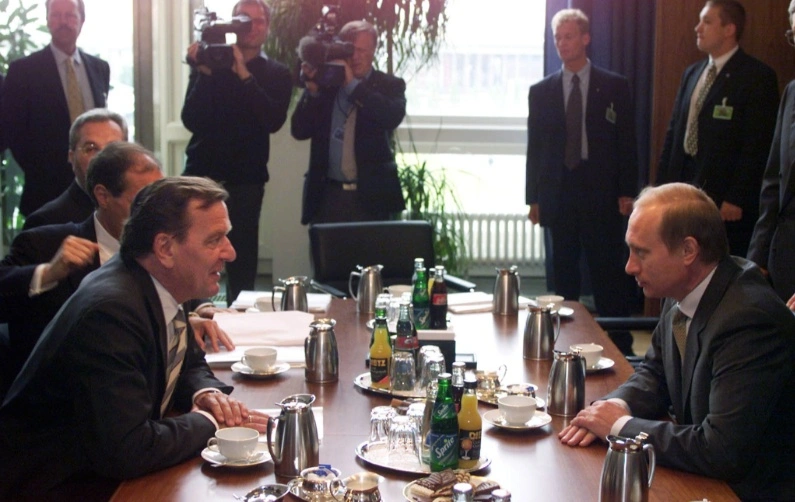
Former German Chancellor Schröder criticised for attending Putin's birthday
Section: News
President Donald Trump is betting that a 25% tariff on imported cars and auto parts will spur production within the United States. Achieving this objective will require a significant overhaul of the global supply chains that the automotive industry has meticulously developed over the decades.
Vehicles are not singular products; they are composed of tens of thousands of components, ranging from transmissions to alternators to individual springs, sourced from around the globe. The question remains: can a successful shift to domestic production really take place? How will automotive manufacturers respond to these tariffs? And is there currently a vehicle that is entirely manufactured in the United States?
The proposed tariffs are expected to impact not just foreign manufacturers but also domestic companies that rely on imported parts. As companies assess the new landscape, many are grappling with the potential increase in production costs. This situation raises concerns over vehicle pricing and the overall market structure.
Moreover, automakers may need to rethink their strategies and operational frameworks to comply with the new tariff regime. Analysts suggest that companies could either absorb the costs, pass them onto consumers, or seek to localize their supply chains to mitigate the tariff impact.
While the ultimate goal is to enhance U.S. manufacturing capabilities, the transition poses significant challenges. The complexity of automotive production, which involves a vast network of suppliers and manufacturers, complicates efforts to shift operations back to the U.S.
Furthermore, questions arise about the feasibility of producing a vehicle entirely in the United States. Currently, no car on the market can claim to be 100% U.S.-made, primarily due to the interconnected nature of global supply chains that have evolved over decades.
In conclusion, as the automotive industry navigates these new tariffs, it will be imperative for manufacturers to adapt quickly to the changing economic landscape. The long-term effects of these tariffs on the industry, consumer prices, and manufacturing jobs remain to be seen.
Section: News

Section: Science

Section: Business

Section: Business

Section: Science

Section: News

Section: Politics

Section: News

Section: Fashion

Section: Arts
Both private Health Insurance in Germany and public insurance, is often complicated to navigate, not to mention expensive. As an expat, you are required to navigate this landscape within weeks of arriving, so check our FAQ on PKV. For our guide on resources and access to agents who can give you a competitive quote, try our PKV Calculator.
Germany is famous for its medical expertise and extensive number of hospitals and clinics. See this comprehensive directory of hospitals and clinics across the country, complete with links to their websites, addresses, contact info, and specializations/services.
Didn't manage to get a ticket for Linkin Park? Or still not enough after the concert? Join us at CRASH on June 12th for our "IN THE END" Linkin Park Special + CORE NIGHT.All night long, we'll be playing Linkin Park's music, along with Nu Metal, Metalcore, and Alternative Rock from bands such as Limp...



No comments yet. Be the first to comment!