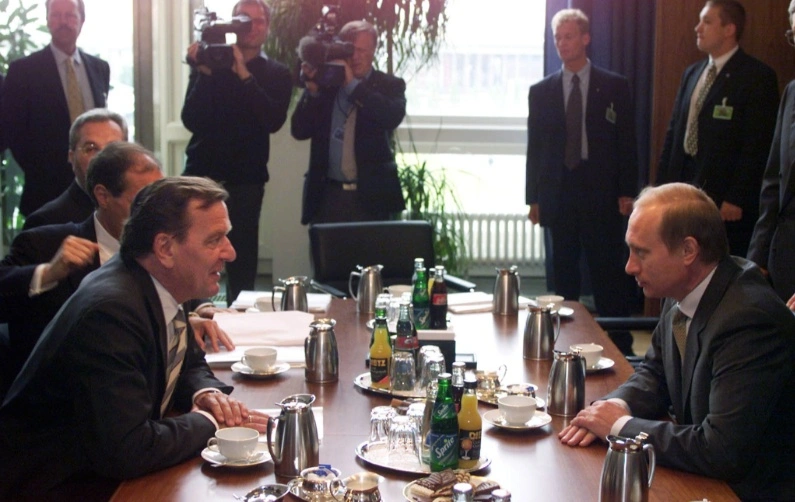
Former German Chancellor Schröder criticised for attending Putin's birthday
Section: News
On the fiftieth anniversary of the death of former Spanish dictator Francisco Franco, Spain's Prime Minister Pedro Sánchez emphasized the country's transformation from authoritarian rule to a stable democracy. Marking the significant date, Sánchez acknowledged Spain's political evolution since Franco's passing, describing the nation's democratic transition as a notable accomplishment in modern European history.
Francisco Franco, who governed Spain following his victory in the 1936-1939 Civil War, led the country through a period of authoritarian rule that spanned nearly four decades. His regime was characterized by political repression and limited civil liberties. Upon Franco's death in 1975, the succession plan he established resulted in Juan Carlos I, grandson of the deposed King Alfonso XIII, ascending to the throne. This change marked the beginning of a new era for Spain.
Under the leadership of Juan Carlos I and subsequent governments, Spain began a process of democratic reform. The country held its first democratic elections in 1977, followed by the adoption of a new constitution in 1978, which laid the foundation for Spain's parliamentary monarchy and democratic governance. In 1981, the fledgling democratic system faced a significant challenge with an attempted coup by right-wing military officers. The intervention of King Juan Carlos I played a pivotal role in upholding the constitutional order, reinforcing the commitment to democracy.
Spain's transition from dictatorship to democracy has often been cited internationally as a model for peaceful and effective political transformation. The process involved not only legal and institutional reforms but also a broader national reconciliation effort, aimed at overcoming the divisions of the past. Despite these achievements, some critics argue that the country has not fully addressed the human rights abuses and crimes committed during the Franco era. Calls for further investigation and remembrance of past injustices continue to be voiced by various organizations and segments of Spanish society.
Prime Minister Sánchez acknowledged ongoing challenges in confronting the nation's past. He emphasized the importance of defending democratic freedoms and cautioned against the resurgence of nostalgia for authoritarianism. Recent years have seen a rise in positive perceptions of Franco's regime among some segments of the Spanish population, particularly among the youth. Social media platforms have contributed to the spread of sentiments suggesting that conditions were better under Franco, a narrative that has gained traction despite the historical record of repression during his rule.
Sánchez also addressed the role of key figures in Spain's democratic transition, referencing recent memoirs by former King Juan Carlos I. While recognizing the contributions of individuals in leadership roles, the Prime Minister highlighted the central role played by ordinary Spanish citizens in achieving and securing democratic freedoms. He stressed that the establishment of democracy was the result of collective action and determination, rather than the work of any single individual or institution.
The commemoration of Franco's death included a memorial service organized by his family, reflecting the continued presence of differing perspectives on his legacy within Spanish society. The ongoing debate over how to remember and interpret the Franco era remains a significant topic in Spain's political discourse, influencing current policy discussions and national identity.
Spain's experience with democratic transition continues to be recognized internationally as an example of peaceful change, yet the complexities of its recent history underscore the importance of ongoing dialogue and remembrance. The government has reiterated its commitment to upholding democratic values and ensuring that the lessons of the past inform the country's future direction.
Section: News

Section: Science

Section: Business

Section: Business
Section: Science

Section: News
Section: Politics
Section: News

Section: Fashion
Section: Arts
Both private Health Insurance in Germany and public insurance, is often complicated to navigate, not to mention expensive. As an expat, you are required to navigate this landscape within weeks of arriving, so check our FAQ on PKV. For our guide on resources and access to agents who can give you a competitive quote, try our PKV Calculator.
Germany is famous for its medical expertise and extensive number of hospitals and clinics. See this comprehensive directory of hospitals and clinics across the country, complete with links to their websites, addresses, contact info, and specializations/services.
Didn't manage to get a ticket for Linkin Park? Or still not enough after the concert? Join us at CRASH on June 12th for our "IN THE END" Linkin Park Special + CORE NIGHT.All night long, we'll be playing Linkin Park's music, along with Nu Metal, Metalcore, and Alternative Rock from bands such as Limp...



No comments yet. Be the first to comment!