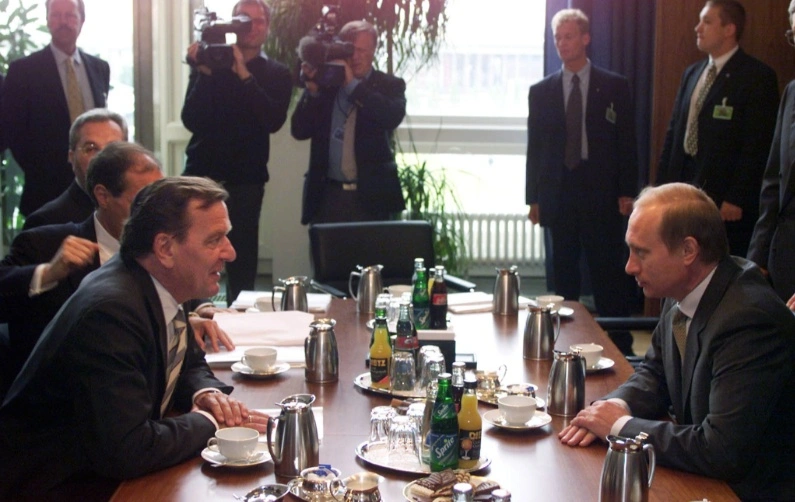
Former German Chancellor Schröder criticised for attending Putin's birthday
Section: News
Amid ongoing debates about Austria's approach to climate policy and public sector reform, Green Party leader Leonore Gewessler has raised pointed concerns regarding the government's recent actions and direction in climate protection and fiscal management.
Following the resignation of Harald Mahrer as President of the Austrian Federal Economic Chamber, Gewessler described the situation as a significant opportunity for institutional reforms. She emphasized the necessity for changes within the chamber, such as a reduction in the Chamber Levy 2, and highlighted that the organization should address issues related to wage increases and its overall structure independently. The resignation was prompted by criticism over salary increases for chamber staff that exceeded inflation, substantial rises in compensation for presidium members, and communication failures. Gewessler also noted that reforms are needed regarding mandatory membership within the chamber.
The government, according to Gewessler, continues to operate without sufficient clarity on the national budget deficit. She described the current financial planning as lacking transparency, echoing concerns raised by other officials, such as the head of the Austrian Health Insurance Fund, who recently predicted a significant deficit for 2029. Gewessler showed support for proposals aimed at centralizing health policy responsibilities at the federal level, stating that citizens are primarily concerned with the functionality of the healthcare system, regardless of which governmental body is responsible. She criticized the fragmented state of health administration, arguing that divided oversight hinders effective governance.
Addressing the intersection of climate policy and fiscal challenges, Gewessler rejected the assertion that climate protection measures are to blame for budget shortfalls. She referenced the government's response during the Russian invasion of Ukraine, which included substantial support packages for individuals and businesses, and maintained that fiscal consolidation should not come at the expense of climate initiatives. Gewessler argued that opportunities exist to reconsider subsidies such as the diesel tax privilege and called for prioritizing environmental reforms.
Gewessler also scrutinized the current climate policies of her successor, Norbert Totschnig, and the broader governmental coalition, which includes the Austrian People's Party (ÖVP), the Social Democratic Party (SPÖ), and NEOS. She questioned the delays in passing key energy legislation and drew attention to ongoing negotiations with the Freedom Party (FPÖ). While the ÖVP has urged the Greens and the FPÖ to support the Electricity Industry Act, the FPÖ has criticized Gewessler's approach as overly ideological and instead called for policies that prioritize affordable fuel and individual transportation options.
The Green Party, according to Gewessler, remains committed to both environmental protection and social concerns. She cited the climate ticket as a measure to promote affordable mobility. However, Gewessler criticized recent government decisions to abolish the climate bonus and increase the price of the climate ticket, in addition to plans to move forward with the Lobau tunnel construction project. She argued that this infrastructure project would not resolve existing traffic issues, but rather exacerbate congestion.
Gewessler urged the government to exert greater influence over energy pricing by state utility providers and to invest in expanding the energy grid. She also questioned the SPÖ's commitment to social policies, referencing the lack of adjustments to family benefits amid rising costs.
On the issue of religious symbols, Gewessler reiterated her opposition to a ban on headscarves, predicting that such legislation would not withstand constitutional scrutiny, as was previously the case.
Overall, Gewessler's statements reflect ongoing tensions within Austria's political landscape regarding climate policy, public sector reform, and social welfare measures, highlighting the challenges facing the government as it seeks to balance fiscal responsibility with environmental and social objectives.
Section: News

Section: Science
Section: Business

Section: Business

Section: Science

Section: News

Section: Politics

Section: News

Section: Fashion
Section: Arts
Both private Health Insurance in Germany and public insurance, is often complicated to navigate, not to mention expensive. As an expat, you are required to navigate this landscape within weeks of arriving, so check our FAQ on PKV. For our guide on resources and access to agents who can give you a competitive quote, try our PKV Calculator.
Germany is famous for its medical expertise and extensive number of hospitals and clinics. See this comprehensive directory of hospitals and clinics across the country, complete with links to their websites, addresses, contact info, and specializations/services.
Didn't manage to get a ticket for Linkin Park? Or still not enough after the concert? Join us at CRASH on June 12th for our "IN THE END" Linkin Park Special + CORE NIGHT.All night long, we'll be playing Linkin Park's music, along with Nu Metal, Metalcore, and Alternative Rock from bands such as Limp...



No comments yet. Be the first to comment!