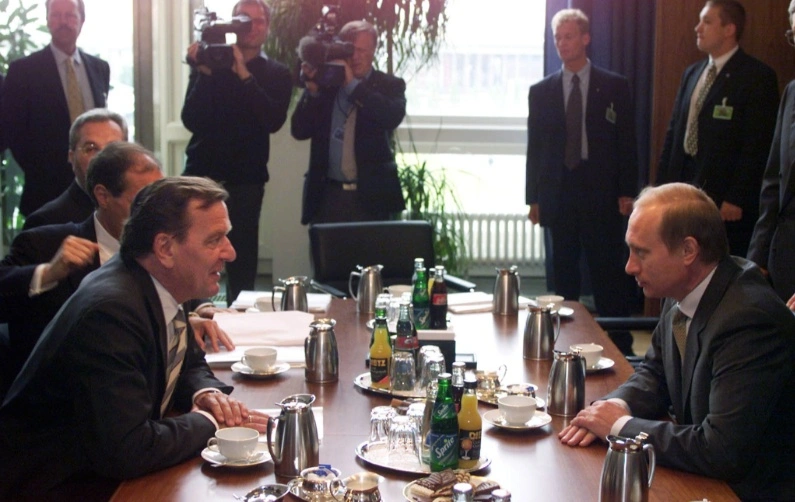
Former German Chancellor Schröder criticised for attending Putin's birthday
Section: News
The ongoing debate regarding the complete relocation of the German federal government from Bonn to Berlin has intensified, with Berlin's governing mayor, Kai Wegner, advocating for the move. Wegner argues that the current practice of frequent official travel between the two cities is not only costly but also detrimental to the environment. With the nation set to celebrate 35 years of German reunification on October 3, Wegner believes it is the opportune moment for a full transition to the capital.
According to Wegner, federal employees currently undertake approximately 20,000 business trips annually between Bonn and Berlin, which he claims could be avoided with a complete government relocation. He emphasizes that many young professionals prefer to work in Berlin, citing better career advancement opportunities. "If they want to have better prospects, they are more likely to consider positions in Berlin," he stated.
The response from Bonn came swiftly, with the city's mayor, Katja Dörner, dismissing Wegner's proposal as outdated and impractical. Dörner's remarks were echoed by members of the North Rhine-Westphalia state government, who criticized the notion of further shifting governmental operations to Berlin. Nathanael Liminski, the state minister for federal and European affairs, labeled Wegner's arguments as misleading, asserting that the realities of modern communication, such as remote work and video conferencing, have minimized the need for physical travel.
Liminski pointed out that the costs associated with maintaining the Bonn-Berlins operations--estimated between 10 and 20 million euros annually--pale in comparison to the potential billions required for a full relocation. He noted that retaining Bonn as a secondary political hub is a sensible strategy, particularly in light of lessons learned from the COVID-19 pandemic and the ongoing conflict in Ukraine.
The Bonn-Berlin Act, established in 1994, facilitated the transfer of government functions to Berlin while mandating that a significant number of positions remain in Bonn. Currently, approximately one-third of federal ministry jobs are still located in Bonn. This arrangement has allowed Bonn to maintain its status as a political center, housing important institutions and corporations, including the UN Climate Secretariat, which plays a crucial role in organizing global climate conferences.
The historical context of Bonn's status as the capital of West Germany during the Cold War is also a significant factor in this debate. Established as the seat of government due to Berlin's division, Bonn was chosen for its relatively less damaged infrastructure after World War II. The city has since evolved, hosting key economic players such as Deutsche Telekom and Deutsche Post.
As the conversation around the government's physical location continues, it is clear that both Berlin and Bonn have their distinct advantages and challenges. The implications of this decision extend beyond mere logistics, touching upon economic, environmental, and social factors that will shape the future of Germany's political landscape.
Section: News

Section: Science
Section: Business

Section: Business
Section: Science
Section: News
Section: Politics
Section: News

Section: Fashion
Section: Arts
Both private Health Insurance in Germany and public insurance, is often complicated to navigate, not to mention expensive. As an expat, you are required to navigate this landscape within weeks of arriving, so check our FAQ on PKV. For our guide on resources and access to agents who can give you a competitive quote, try our PKV Calculator.
Germany is famous for its medical expertise and extensive number of hospitals and clinics. See this comprehensive directory of hospitals and clinics across the country, complete with links to their websites, addresses, contact info, and specializations/services.
Didn't manage to get a ticket for Linkin Park? Or still not enough after the concert? Join us at CRASH on June 12th for our "IN THE END" Linkin Park Special + CORE NIGHT.All night long, we'll be playing Linkin Park's music, along with Nu Metal, Metalcore, and Alternative Rock from bands such as Limp...



No comments yet. Be the first to comment!