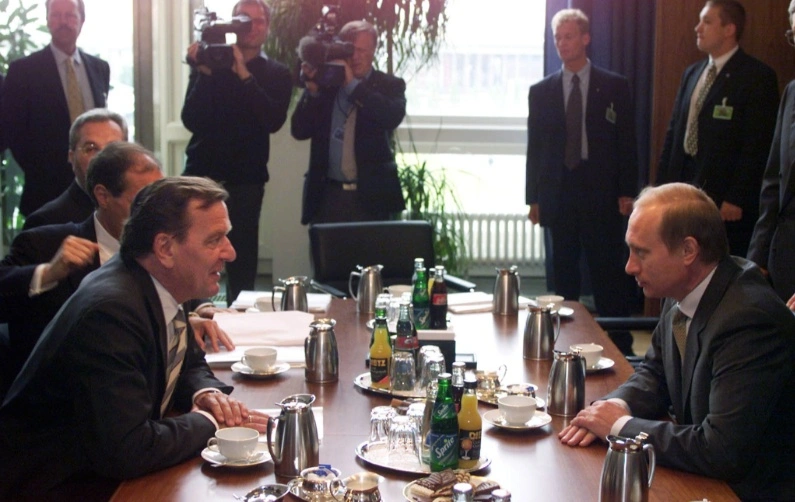
Former German Chancellor Schröder criticised for attending Putin's birthday
Section: News
The ongoing negotiations concerning Iran's nuclear program have entered a pivotal stage as discussions between Washington and Tehran are set to resume. This latest round of talks is taking place in Rome, where U.S. Special Envoy Steve Witkoff and Iranian Foreign Minister Abbas Araghchi are meeting for the fifth time, facilitated by the Gulf state of Oman, as reported by Iranian state media.
A significant number of journalists gathered outside the Omani embassy in Rome, where multiple delegations arrived for the discussions. Initially optimistic when talks began in mid-April, both sides have since revealed substantial differences following their latest meeting in Muscat two weeks ago. Observers suggest that these negotiations are now at a critical juncture.
U.S. State Department spokesperson Tammy Bruce indicated that this fifth round of negotiations is occurring because the United States believes an agreement is achievable. She stated that the Iranian side understands U.S. demands and continues to engage in the discussions. The U.S. has called for Iran to completely halt its uranium enrichment activities, which Washington considers essential to prevent the development of Iranian nuclear weapons.
While Tehran has rejected this demand outright, it has expressed a willingness to limit its nuclear program and allow for stricter oversight. Foreign Minister Araghchi recently emphasized on social media that reaching an agreement is not overly complicated, asserting that a deal could be reached if Iran commits to not developing nuclear weapons. Conversely, he warned that if Iran is required to cease all enrichment, no agreement would be possible.
Central to the dispute over Iran's nuclear program is the intended use of enriched uranium. Tehran insists that its program is solely for peaceful purposes, while Western governments remain concerned about the potential for nuclear weapons development. In recent statements, former U.S. President Donald Trump threatened military action against Iran if no agreement is reached.
In 2015, Iran had previously agreed to limit its nuclear activities under the Joint Comprehensive Plan of Action (JCPOA) following extensive negotiations with China, Russia, the U.S., France, Germany, and the U.K. However, Trump unilaterally withdrew the U.S. from the agreement in 2018 and reinstated stringent sanctions. Currently, Iran is enriching uranium to a purity level of 60%, whereas experts indicate that levels over 90% are necessary for weapons-grade material. Under the JCPOA, Iran was restricted to a maximum enrichment level of 3.67% and allowed to maintain a stockpile of up to 300 kilograms of uranium for civilian energy production.
Meanwhile, reports suggest that Israel may be preparing for a potential military strike against Iranian nuclear facilities. U.S. officials have received indications that Israel is taking steps in this direction, although it remains unclear if a definitive decision has been made by the Israeli government. In response, Araghchi has addressed the United Nations and the International Atomic Energy Agency (IAEA), cautioning about the repercussions of any Israeli military action, stating that the U.S. would also bear responsibility if such an event occurs.
The General Staff of Iran has issued warnings regarding possible military action, suggesting that any aggression from the U.S. could lead to consequences similar to those faced in Vietnam and Afghanistan.
Tehran is linking the prospect of a renewed agreement to a reduction of military tensions in the region and the lifting of sanctions. With its political and economic isolation over the years, Iran has significantly strengthened its ties with China and Russia through strategic partnerships.
Section: News

Section: Science
Section: Business

Section: Business
Section: Science
Section: News
Section: Politics
Section: News

Section: Fashion
Section: Arts
Both private Health Insurance in Germany and public insurance, is often complicated to navigate, not to mention expensive. As an expat, you are required to navigate this landscape within weeks of arriving, so check our FAQ on PKV. For our guide on resources and access to agents who can give you a competitive quote, try our PKV Calculator.
Germany is famous for its medical expertise and extensive number of hospitals and clinics. See this comprehensive directory of hospitals and clinics across the country, complete with links to their websites, addresses, contact info, and specializations/services.
Didn't manage to get a ticket for Linkin Park? Or still not enough after the concert? Join us at CRASH on June 12th for our "IN THE END" Linkin Park Special + CORE NIGHT.All night long, we'll be playing Linkin Park's music, along with Nu Metal, Metalcore, and Alternative Rock from bands such as Limp...



No comments yet. Be the first to comment!