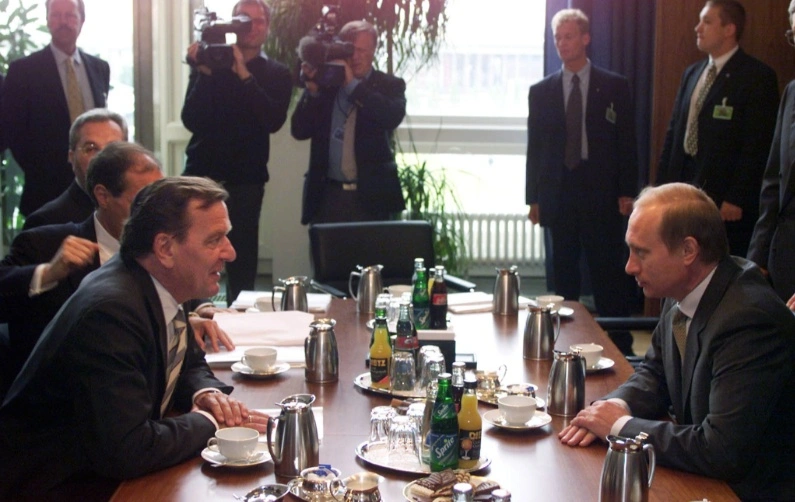
Former German Chancellor Schröder criticised for attending Putin's birthday
Section: News
The Austrian People's Party (ÖVP) recently experienced significant internal upheaval following widespread calls for the resignation of Harald Mahrer, President of the Austrian Federal Economic Chamber and a leading figure in the party. The controversy began after it was revealed that the Economic Chamber approved a 4.2 percent salary increase for its officials during a period of economic austerity, prompting discontent not only among party members but also within the broader public.
Key regional leaders, including the governors of Lower and Upper Austria as well as several prominent business representatives, were among those demanding Mahrer step down. This signaled a rare and public split within the party, as some factions pushed for accountability while others advocated for allowing Mahrer the opportunity to address the issues himself. The ÖVP's federal leadership initially expressed support for Mahrer, emphasizing the need for internal correction rather than immediate resignation.
The situation further escalated after the details of the pay raise came to light, coinciding with government efforts to keep public sector wage increases moderate. This juxtaposition led to criticism from both within the party and the chancellor's office, which expressed dissatisfaction with the Chamber's decision. The handling of the controversy, particularly Mahrer's communication strategy, contributed to growing frustration among party members. A temporary compromise was proposed, halving the salary increase, but it later emerged that the full raise would be implemented after six months, undermining confidence in the leadership's transparency.
The episode highlighted broader tensions within the ÖVP, as regional leaders openly challenged the federal party line. The issue was compounded by dissatisfaction with Mahrer's recent public statements, where he called for greater government efficiency and criticized the public sector. These comments were perceived as contradictory in light of the Chamber's decision on salary increases.
Grassroots feedback from party members and the business community reflected deep concern over the use of mandatory membership fees and the perceived disconnect between the leadership and its base. While some acknowledged Mahrer's contributions to the party, including his work on modernizing the party's platform and his involvement in coalition negotiations, the prevailing sentiment was that the controversy had irreparably damaged his standing.
In response to mounting pressure, Mahrer offered his resignation from his position at the National Bank in an attempt to retain his Economic Chamber role. However, this move failed to quell discontent within the party and its affiliated organizations. The incident has sparked a broader debate within the ÖVP about accountability, communication, and the expectations of leadership in times of public scrutiny.
Observers note that the episode marks a significant challenge to internal party unity, highlighting the evolving relationship between regional and federal structures within Austria's leading political force. The outcome of this dispute may set important precedents for future leadership and governance within the ÖVP.
Section: News

Section: Science
Section: Business

Section: Business

Section: Science

Section: News

Section: Politics

Section: News

Section: Fashion
Section: Arts
Both private Health Insurance in Germany and public insurance, is often complicated to navigate, not to mention expensive. As an expat, you are required to navigate this landscape within weeks of arriving, so check our FAQ on PKV. For our guide on resources and access to agents who can give you a competitive quote, try our PKV Calculator.
Germany is famous for its medical expertise and extensive number of hospitals and clinics. See this comprehensive directory of hospitals and clinics across the country, complete with links to their websites, addresses, contact info, and specializations/services.
Didn't manage to get a ticket for Linkin Park? Or still not enough after the concert? Join us at CRASH on June 12th for our "IN THE END" Linkin Park Special + CORE NIGHT.All night long, we'll be playing Linkin Park's music, along with Nu Metal, Metalcore, and Alternative Rock from bands such as Limp...



No comments yet. Be the first to comment!