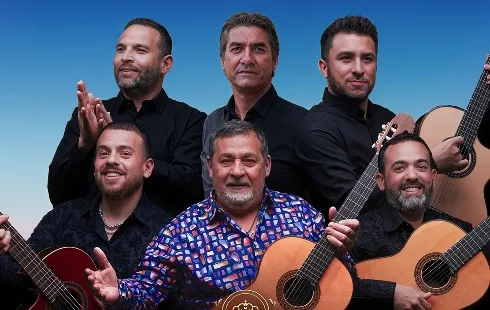
Gipsy Kings: "Music Is a Natural Way of Life"
Section: Arts
An inmate on death row in the United States narrowly avoided execution after the governor of Oklahoma intervened at the last possible moment. Governor Kevin Stitt announced that he had commuted the sentence of Tremane Wood, who had been convicted of murder, changing it from capital punishment to life imprisonment without the possibility of parole. This decision was made shortly before the scheduled execution by lethal injection was set to proceed.
The state's parole board had recently reviewed Wood's case, ultimately recommending by a vote of three to two that his sentence be commuted. Wood, aged 46, had been found guilty of murdering a 19-year-old during a robbery in 2002. Despite his conviction, Wood maintained that he was not responsible for the killing. The board's recommendation prompted the governor's action, granting Wood a reprieve from execution just hours before it was to take place.
While this commutation spared Wood, the use of capital punishment remains prevalent in the United States. Two other executions were scheduled to occur in the days following the governor's announcement. In Florida, a 66-year-old former Marine named Bryan Jennings was slated for execution by lethal injection, having been convicted of the rape and murder of a six-year-old child in 1979. Meanwhile, in South Carolina, authorities planned to carry out the execution of Stephen Bryant, aged 44, by firing squad. Bryant had confessed to the killing of three individuals in 2004.
According to recent data, the United States has carried out 41 executions so far this year, marking the highest annual total since 2012, when 43 executions took place. Florida currently leads the nation, accounting for 15 of these executions. Despite international criticism and the abolition of the death penalty in many countries, capital punishment remains legal in 24 of the 50 US states. The continued use of the death penalty in the United States is a subject of ongoing public debate and legal scrutiny.
Supporters of capital punishment argue that it serves as a deterrent to serious crime and provides justice for victims. However, opponents highlight concerns about wrongful convictions, the effectiveness of capital punishment as a deterrent, and the ethical implications of state-sanctioned executions. The recent commutation in Oklahoma underscores the complexity and controversy surrounding the issue in the US criminal justice system.
The federal government's stance on the death penalty has also influenced its application at the state level. Some recent US administrations have expressed support for maintaining capital punishment, while others have advocated for its abolition or a moratorium on federal executions. Despite these differing approaches, the majority of executions in the United States are carried out at the state level, where governors and parole boards play a significant role in determining whether sentences are upheld or commuted.
As the debate over the death penalty continues, the commutation of Tremane Wood's sentence in Oklahoma highlights both the power of executive clemency and the ongoing national discussion about the future of capital punishment in the United States.
Section: Arts

Section: Fashion

Section: Health Insurance

Section: News

Section: Politics
Section: Business

Section: Health

Section: Arts

Section: Politics

Section: Business
Both private Health Insurance in Germany and public insurance, is often complicated to navigate, not to mention expensive. As an expat, you are required to navigate this landscape within weeks of arriving, so check our FAQ on PKV. For our guide on resources and access to agents who can give you a competitive quote, try our PKV Cost comparison tool.
Germany is famous for its medical expertise and extensive number of hospitals and clinics. See this comprehensive directory of hospitals and clinics across the country, complete with links to their websites, addresses, contact info, and specializations/services.
Didn't manage to get a ticket for Linkin Park? Or still not enough after the concert? Join us at CRASH on June 12th for our "IN THE END" Linkin Park Special + CORE NIGHT.All night long, we'll be playing Linkin Park's music, along with Nu Metal, Metalcore, and Alternative Rock from bands such as Limp...



No comments yet. Be the first to comment!