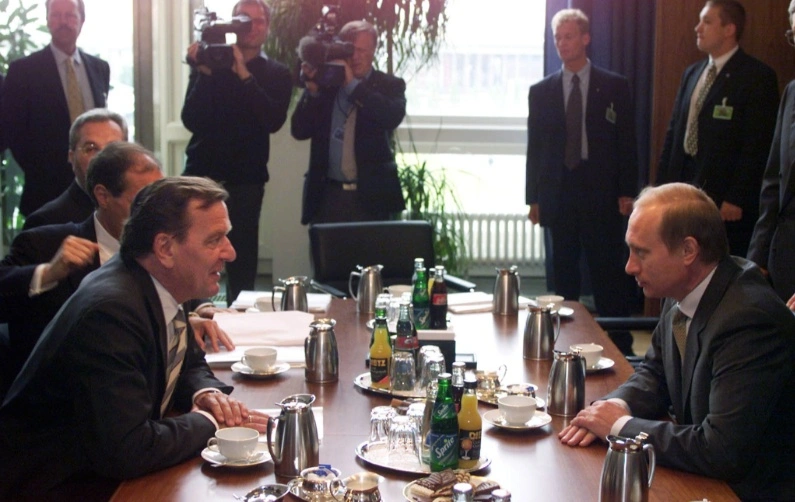
Former German Chancellor Schröder criticised for attending Putin's birthday
Section: News
The recent decision to invite Reza Pahlavi, the exiled crown prince of Iran, to address the Swedish parliament has sparked significant debate regarding the representation and legitimacy of Iran's opposition movements outside the country. The invitation, extended by certain parliamentary groups, has raised questions about how exiled figures are positioned within Western political contexts, especially in relation to complex internal dynamics within Iran.
During the past year, widespread protests in Iran have largely centered on demands for civil liberties and an end to government repression. The demonstrators, operating without centralized leadership, have advocated for freedom and an end to state control over daily life. Notably, calls for a return to monarchy or allegiance to exiled leaders have not featured prominently among protestors' demands. The decentralized and grassroots nature of these protests has posed challenges for external observers seeking a clearly defined opposition figure or movement to engage with.
In international political arenas, there is often a tendency to seek out recognizable individuals who can serve as interlocutors with fragmented or leaderless movements. Historical parallels can be drawn from other contexts; for example, exile figures have previously been positioned as representatives of opposition in countries such as Iraq and Afghanistan, despite lacking broad-based support on the ground. In these cases, external legitimacy did not always translate into effective national representation or political influence.
The invitation for Reza Pahlavi to speak at the Swedish parliament follows this pattern. As a royal figure with a well-known family legacy, he presents a clear narrative that can be more easily communicated in Western settings. However, this approach may risk oversimplifying or misrepresenting the diverse and decentralized character of Iran's current protest movement, which has not been aligned with monarchist ambitions or any singular leadership.
Iran's history under the monarchy, particularly during the reign of Mohammad Reza Pahlavi, is marked by periods of political repression, censorship, and the systematic targeting of opposition groups. The 1979 revolution, which resulted in the establishment of the Islamic Republic, was in large part a response to these authoritarian practices. The prospect of reinstating the monarchy as a political alternative is therefore viewed by many as a significant reinterpretation of Iran's modern history.
Critics of the Swedish parliament's decision point out that offering a high-profile platform to an exiled royal figure can confer a form of political legitimacy that has not been granted by the Iranian populace or by the current grassroots movement. The parliamentary stage is not a neutral space; it has the power to transform an individual voice into a representative one, potentially affecting how the international community perceives the opposition in Iran.
The involvement of specific political parties in extending the invitation--namely, the Christian Democrats and Sweden Democrats--also adds a layer of domestic political calculation. Observers are questioning the timing and motives behind the invitation, as well as its implications for Sweden's role in broader international discussions on Iran.
Ultimately, the debate centers on how external actors, such as national parliaments, engage with opposition movements that are fundamentally decentralized and anti-authoritarian. The manner in which these movements are represented abroad can have far-reaching implications for both their perceived legitimacy and the historical narratives that inform international policy.
Section: News

Section: Science

Section: Business

Section: Business

Section: Science

Section: News

Section: Politics

Section: News

Section: Fashion
Section: Arts
Both private Health Insurance in Germany and public insurance, is often complicated to navigate, not to mention expensive. As an expat, you are required to navigate this landscape within weeks of arriving, so check our FAQ on PKV. For our guide on resources and access to agents who can give you a competitive quote, try our PKV Calculator.
Germany is famous for its medical expertise and extensive number of hospitals and clinics. See this comprehensive directory of hospitals and clinics across the country, complete with links to their websites, addresses, contact info, and specializations/services.
Didn't manage to get a ticket for Linkin Park? Or still not enough after the concert? Join us at CRASH on June 12th for our "IN THE END" Linkin Park Special + CORE NIGHT.All night long, we'll be playing Linkin Park's music, along with Nu Metal, Metalcore, and Alternative Rock from bands such as Limp...



No comments yet. Be the first to comment!