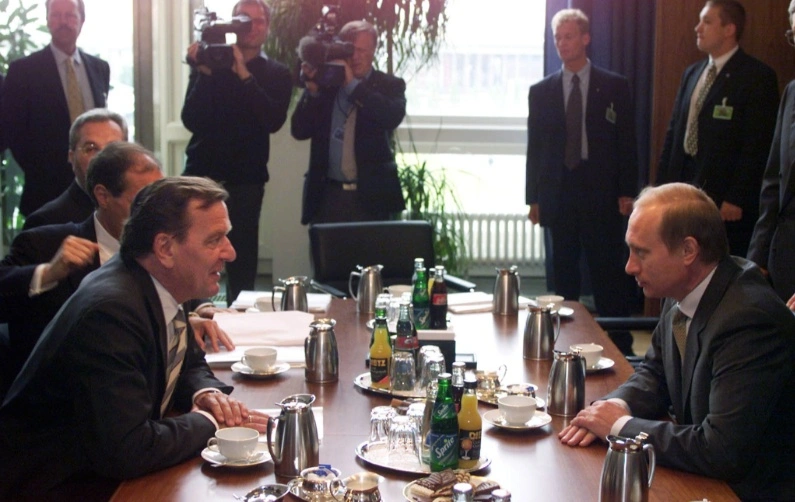
Former German Chancellor Schröder criticised for attending Putin's birthday
Section: News
As the conflict in Ukraine enters its fourth year, the Russian economy is facing significant challenges. In the first quarter of 2025, the growth rate slowed to just 1.4% compared to the same period in 2023, with a notable decline from the previous quarter, marking the first contraction since the onset of the war in February 2022. Industrial production has shown minimal growth of only 1%, and outside of the defense sector, it has actually decreased.
The Central Bank of Russia, having maintained an extraordinarily high interest rate of 21%, has begun to reduce this rate, yet it remains cautious about the economic outlook. Concerns are growing that several large companies outside the financial sector may face bankruptcy this year, with predictions suggesting that up to a dozen of the nation's 78 largest firms could collapse.
Despite these bleak economic indicators, there are unexpected developments within the Russian economy that warrant attention. The macroeconomic outlook has soured considerably, with forecasts indicating that after two years of impressive growth rates of 4.1%, the economy may only achieve a 1.5% increase in 2025. Some experts warn of a potential recession, as articulated by Oleg Vjugin, a former deputy governor of the Central Bank, in a recent interview.
Financial projections have also been revised, anticipating a tripling of the budget deficit to 1.7% of the GDP. This spike in deficit is attributed to rising expenditures, particularly for military purposes, juxtaposed with a forecasted 24% decline in revenue from oil and gas exports, which is projected to reach 8.3 trillion rubles (approximately 92 billion euros).
In light of these challenges, the Russian government faces a critical juncture, balancing military spending with the need to stabilize its economy. Observers are keenly watching how these dynamics will unfold, particularly in terms of the nation's fiscal health and its ability to support key industries amid decreasing global demand for energy resources.
While the overall economic landscape appears dire, the notable increase in Russian gold reserves presents a counter-narrative. Many analysts are intrigued by this phenomenon, as it could signal a strategic shift in Russia's economic policy aimed at bolstering its financial stability in the face of international sanctions and fluctuating oil prices. The implications of this gold reserve buildup could be significant, potentially positioning Russia to maneuver more effectively through the ongoing economic turbulence.
Section: News

Section: Science
Section: Business

Section: Business
Section: Science

Section: News
Section: Politics
Section: News

Section: Fashion

Section: Arts
Both private Health Insurance in Germany and public insurance, is often complicated to navigate, not to mention expensive. As an expat, you are required to navigate this landscape within weeks of arriving, so check our FAQ on PKV. For our guide on resources and access to agents who can give you a competitive quote, try our PKV Calculator.
Germany is famous for its medical expertise and extensive number of hospitals and clinics. See this comprehensive directory of hospitals and clinics across the country, complete with links to their websites, addresses, contact info, and specializations/services.
Didn't manage to get a ticket for Linkin Park? Or still not enough after the concert? Join us at CRASH on June 12th for our "IN THE END" Linkin Park Special + CORE NIGHT.All night long, we'll be playing Linkin Park's music, along with Nu Metal, Metalcore, and Alternative Rock from bands such as Limp...



No comments yet. Be the first to comment!