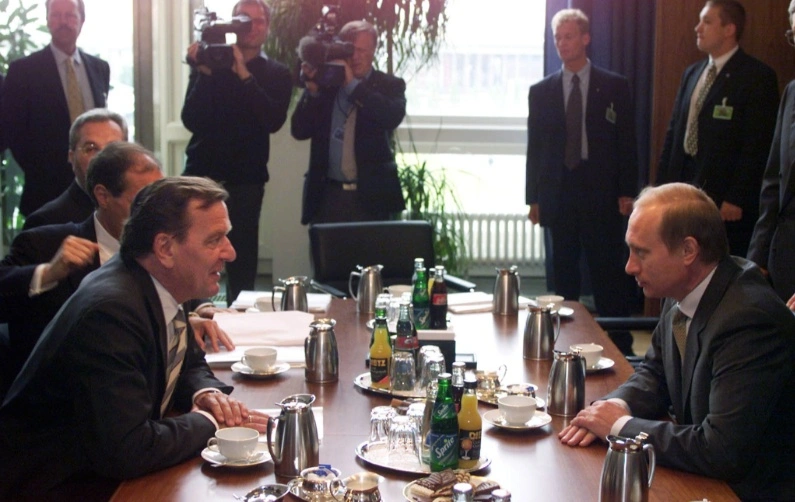
Former German Chancellor Schröder criticised for attending Putin's birthday
Section: News
Austria is projected to remain among the lowest-performing economies in the European Union in 2026, according to the latest economic outlook released in Brussels. The European Commission forecasts Austria's gross domestic product (GDP) to grow by only 0.9 percent in 2026, placing it near the bottom of the EU growth rankings. Only Ireland, with 0.2 percent, and Italy, at 0.8 percent, are expected to fare worse.
By comparison, Malta is forecasted to lead EU growth with a 3.8 percent increase, closely followed by Poland at 3.5 percent. For the broader EU, average GDP growth is expected to reach 1.4 percent, while the Eurozone is projected to see a 1.2 percent rise. For Austria, the Commission expects a modest 0.3 percent growth in 2025 and a slight improvement to 1.2 percent in 2027. These figures, while still subdued, mark a positive revision from earlier projections that had anticipated a third consecutive year of economic contraction for Austria.
Austria's fiscal position remains a concern. The country's budget deficit is forecasted to reach 4.4 percent of GDP in 2025, substantially exceeding the EU's 3.0 percent threshold. The deficit is expected to narrow slightly to 4.1 percent in 2026 but may rise again to 4.3 percent in 2027. This places Austria among several EU countries--including Germany, Belgium, Estonia, France, Slovakia, Finland, Hungary, Poland, and Romania--that are projected to fail to meet the Maastricht deficit criteria by 2026.
The European Commission plans to issue its Autumn economic policy recommendations to member states next week, with special attention on Austria due to an ongoing EU deficit procedure. These recommendations are part of the broader European Semester, which monitors and guides economic and budgetary policies across the bloc.
Inflation remains another challenge for Austria. The inflation rate is expected to reach 3.5 percent in 2025, significantly higher than the EU average of 2.5 percent and the Eurozone's 2.1 percent. Projections indicate that Austrian inflation will moderate to 2.4 percent in 2026 and 2.2 percent in 2027. By contrast, inflation in the Eurozone is anticipated to stabilize at 1.9 percent in 2026 and 2.0 percent in 2027, aligning with the European Central Bank's target. The EU-wide inflation rate is projected at 2.1 percent in 2026 and 2.2 percent in 2027.
The Commission highlighted that economic growth in the first three quarters of 2025 surpassed expectations, initially driven by increased exports ahead of anticipated tariff changes. Despite challenging external conditions, moderate growth is forecasted for the EU in the coming years.
Valdis Dombrovskis, European Commission Vice-President, emphasized the need for vigilance regarding rising debt and deficit ratios across member states. He noted that ongoing uncertainties--particularly those related to global trade policy decisions by the United States and potential reactions from major economies like China--could impact the European economy. The current forecasts assume that all tariffs imposed or credibly announced by the US will remain in place throughout the forecast period, with the Commission warning that the effects of such trade measures could be more pronounced than currently estimated.
Within Austria, calls have intensified for comprehensive measures to improve economic competitiveness. Stakeholders in the Austrian business sector stress the importance of reducing bureaucratic barriers and supporting innovative enterprises. A streamlined regulatory environment and better access to affordable energy and financing are identified as critical factors for strengthening Austria's economic position and fostering future growth.
The Federation of Austrian Industries has described the latest forecast as a signal for urgent structural reforms, citing high labor costs, above-average inflation, expensive energy, and heavy regulatory burdens as key obstacles to competitiveness. Economic experts urge the government to implement effective cost-cutting measures and promote innovation to ensure sustainable growth and fiscal stability.
Section: News

Section: Science
Section: Business

Section: Business
Section: Science
Section: News
Section: Politics
Section: News

Section: Fashion
Section: Arts
Both private Health Insurance in Germany and public insurance, is often complicated to navigate, not to mention expensive. As an expat, you are required to navigate this landscape within weeks of arriving, so check our FAQ on PKV. For our guide on resources and access to agents who can give you a competitive quote, try our PKV Calculator.
Germany is famous for its medical expertise and extensive number of hospitals and clinics. See this comprehensive directory of hospitals and clinics across the country, complete with links to their websites, addresses, contact info, and specializations/services.
Didn't manage to get a ticket for Linkin Park? Or still not enough after the concert? Join us at CRASH on June 12th for our "IN THE END" Linkin Park Special + CORE NIGHT.All night long, we'll be playing Linkin Park's music, along with Nu Metal, Metalcore, and Alternative Rock from bands such as Limp...



No comments yet. Be the first to comment!