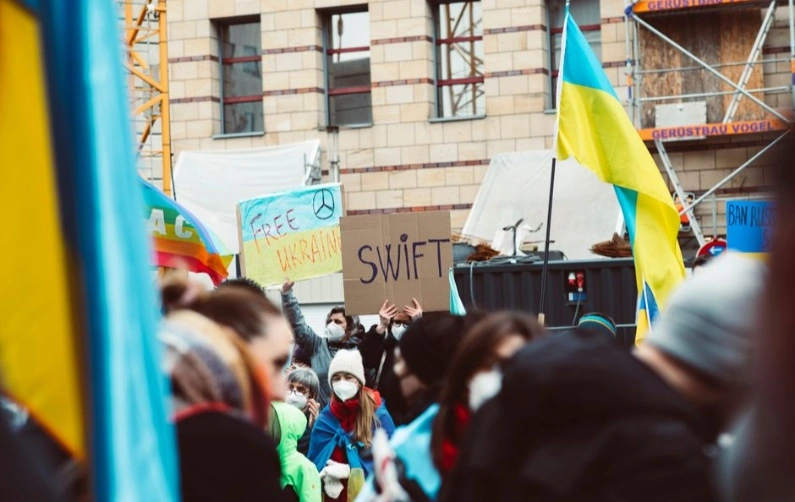
Majority in Germany sees Russia as a threat and supports tougher stance
Section: Politics
The European Union is reportedly importing Russian ammonia despite ongoing sanctions, facilitated by a legal "EU special quota". This development has raised eyebrows as participating companies are said to have connections to oligarchs close to Russian President Vladimir Putin and the explosives industry.
On October 5, the tanker "Eco Sorcerer" docked once more at the chemical port of Antwerp carrying over 20,000 tonnes of Russian ammonia. Footage captured by journalists shows the ship docking in a port area jointly operated by BASF and EuroChem, a Russian chemical company. The vessel had been loaded in the Russian port of Ust Luga, a detail confirmed by several weeks of satellite data analysis.
Russian ammonia, produced predominantly from natural gas, is a significant asset for the nation. The production and export facilities have been bolstered by substantial investments, even as Russia continues to face restrictions on its direct energy exports, such as natural gas. This strategic expansion aligns with a 2014 strategy from the Russian Ministry of Energy, which aimed to significantly increase ammonia production by the year 2030.
Sanktion expert Benjamin Hilgenstock from the Kyiv School of Economics explains that Russia is systematically adapting to sanctions, using its energy resources for indirect exports to still generate revenue. This method has allowed Russia to circumvent some of the economic impacts of direct export prohibitions.
The EU Parliament has expressed intentions to halt such trade by 2025. However, Luxembourg MEP Isabel Wiseler-Lima, representing the Christian Democrats, noted that compromises frequently emerge due to the influence of Russia-friendly lawmakers within the EU, which complicates the enforcement of strict sanctions.
According to investigations, EuroChem is central to this import activity. The company is identified as having integrated its operations closely with prominent European chemical firms such as BASF. Despite the ostensibly legal framework of these transactions, they highlight the complexity and loopholes in sanction enforcement, particularly in industries reliant on chemical feedstocks like fertilizers, where ammonia is commonly used as a raw material.
Although Europe has made significant strides to reduce its dependency on Russian energy, the ammonia trade persists, providing lucrative financial benefits to Russia. The ongoing imports effectively enable Russia to leverage its robust natural resources while circumventing some sanctions' impact.
Reportedly, the Russian strategy involves further expanding its ammonia production capabilities and enhancing the infrastructure for exports. The development is allegedly backed by investments that could amplify Russia's share in the global ammonia trade, projected to expand significantly by the next decade as per strategic governmental plans.
The revelations about EU imports of Russian ammonia underscore the intricate balance between maintaining critical industrial supplies and enforcing economic sanctions designed to pressure Russia amid geopolitical tensions. The situation continues to provoke debate within European policy-making circles on strategizing sanctions that efficiently curb trade without disrupting key industrial sectors reliant on imported materials such as ammonia.
Source: tagesschau.de
Section: Politics
Section: News
Section: News
Section: News
Section: News
Section: Fashion
Section: News
Section: Business
Section: News
Section: Business
Both private Health Insurance in Germany and public insurance, is often complicated to navigate, not to mention expensive. As an expat, you are required to navigate this landscape within weeks of arriving, so check our FAQ on PKV. For our guide on resources and access to agents who can give you a competitive quote, try our PKV Calculator.
Germany is famous for its medical expertise and extensive number of hospitals and clinics. See this comprehensive directory of hospitals and clinics across the country, complete with links to their websites, addresses, contact info, and specializations/services.
Didn't manage to get a ticket for Linkin Park? Or still not enough after the concert? Join us at CRASH on June 12th for our "IN THE END" Linkin Park Special + CORE NIGHT.All night long, we'll be playing Linkin Park's music, along with Nu Metal, Metalcore, and Alternative Rock from bands such as Limp...

No comments yet. Be the first to comment!